

I went no higher than the first deck of the Eiffel Tower. I reasoned that I was safe, the worst that could happen might be that I tripped and fell down the metal stairs, but it would be impossible to fall all the way to the ground, since I was protected by railings and girders and the care and foresight of the engineers that built the structure. I was safe.
Yet I was unable to shake the irrational fear that the tower might tilt and the railings might buckle, and I would plunge headfirst to the ground, there to die an agonizing death. Unbeknownst to my companions, my heart was racing and I was unable to catch my breath.
“Gentlemen,” I said. “This climbing bores me greatly and the crowds are insufferable. If you don’t mind, I will go back down and meet you when you are finished.”
My two companions, like me, were cycling enthusiasts, came to Paris from London to see the conclusion of the Tour de France racing competition. It was to be an action-packed long weekend for the three amigos, and we agreed to embrace robust activities being Sporting Men of a certain type.
Jerome,bearded and bear-like, was a prop-forward of merit, and a jolly fellow. Horace, tall and patrician, favored clay-pigeon shooting. I, on the other hand, was sportsman of the more cerebral kind, seeing in others their strengths and weaknesses better than they, and as such, I was quick and liberal with judicial advice and therefore highly regarded by practitioners for my technical expertise.
Jerome and Horace congratulated me on my insouciance, and then, like excited schoolboys, proceeded onwards and upwards, thankfully without noticing that I gripped the railing behind my back so tightly that my knuckles ached.
When they were gone, I breathed deep, let go my grip on the tower, and hurriedly descended the steps, my eyes focused on the back and shoulders of the man in front of me.
“I trust you enjoyed the view?” I said when my friends were earthbound again.
“Splendid view of the city, “ said Horace, whose height lent gravity to his far-away gaze; it was as if he could see things that others could not.
“Dashed, if it isn’t blessed hot back here on the ground though ,” said Jerome, clawing at his Eton collar, over which his thick neck bulged. “It was much cooler aloft.” He was red-faced and perspiring.
It was July, the paving stones reflected the heat of the sun, creating a notable updraft of warm air.
“If we three men were in a balloon, I am sure this heat would take us soaring higher than the Eiffel tower and therefore cool our brows.
Horace and Jerome grinned, Horace clapped his hands in delight.
“By Jove, Clarence, you are clairvoyant,” said Jerome.
“Oh, top hole,” said Horace. “Clarence, clairvoyance, I see clearly, where you are headed.”
Both men laughed. Horace slapped me on the shoulder.
I, Clarence, merely raised my eyebrows, practicing my nonchalance, which only caused them more mirth. Apparently, I was not in on a joke.
It took just fifteen minutes to reach the Balloon Park, on grassy fields near the Porte Maillot. I dare not decline an ascent a second time, and I silently cursed Jerome and Horace, as they marched me toward the ticket booth.
“Tickets for three,” said Horace loudly, in English.
The young woman in the booth closed her eyes and seemed to offer a prayer.
I hoped it was in our favor, but she was surly when she handed over the tickets.
We turned and assessed the hydrogen balloon that was tethered to the earth by a cable. It was a balloon of the ‘captive’ kind, which rose aloft on the cable, and was pulled back down by the same means. I felt my heart race again, the sweat upon my forehead and my knees turned to jelly.
I was now in on the joke.
I could not decline the challenge a second time. It would be poor show.
We embarked into the large ring-shaped basket, eight feet diameter, with a three-foot hole in the middle, through which the tether-line attached to the webbing that shrouded the huge spherical hydrogen balloon. I noted with relief that the basket was high-sided, presenting refuge; were my knees to give way, I would collapse on the floor of the basket, close my eyes, and meet fate veiled in ignorance rather than in a stare of conscious cowardice.
Little did I know that such recourse would not be available to me, nor to my companions and the other passengers. Including the pilot, there were nine of us, the three amigos, two intrepid young women, a sailor, and two middle-aged men. But for the women, I might not have climbed the ladder and boarded the aircraft.
The pilot was a nattily dressed man, with a pretentious captain’s hat and a waxed moustache that curled upwards at the ends, and which gave him the appearance of aloofness that I found repellent.
He made a show of inspecting the equipment and the passengers, gave us instructions on what to do, what not to do, and was – in all things – more organized and commanding than you might expect of a Frenchman, but haughty to a fault.
He smiled at me, but not warmly. He seemed to judge me as wanting, as I did him.
Having conducted his safety checks he instructed the winchman below to let loose the ratchet so that cable might run out and we might elevate, which we did for a few seconds, but at a height of about 20 feet – my nerves already fraying – the pilot shouted instructions and waved to the winch operator that we should stop.
And so, we were only 20 feet above ground when the wind struck us like a Tsunami wave.
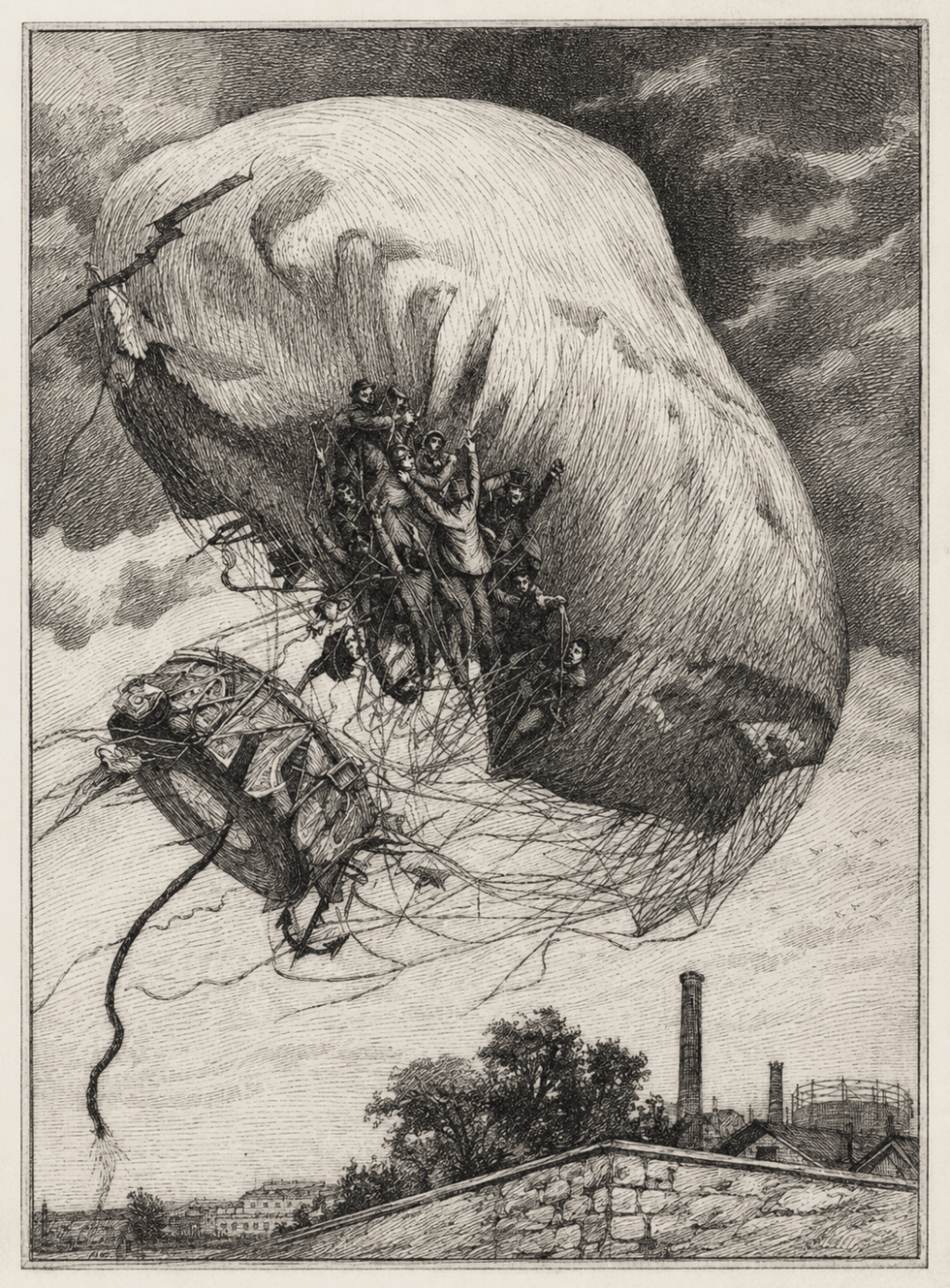
From where it had come was immediately obvious on turning to the face the blast. It came from the North pushed along by ink black thunder clouds that rushed up at us, bringing violent wind, and the sting of dead leaves and dust blown from the dry trees nearby. The balloon was thrown about like a toy, and us with it. Hands gripped what they could. Faces blanched, jaws set firm, or mouths open and crying. The cradle whipped side to side, the ropes screamed at the strain and the giant silk balloon wallowed back and forth.
And then a gust hit us.
A crack like rifle fire.
The cable snapped.
We were flung skyward by the storm, and quickly soared above the gardens, the Seine river, and the Eiffel Tower raced away from us. We were higher than the first deck, higher than the second, and soon we were heading toward the clouds.
Blood rushed to my feet, and my heart and lungs fell toward my stomach. The noise was that of a steam engine roaring at top speed. The sky flashed. The basket cried. The silk balloon seemed to be expanding, pressing hard against the webbing, and for some reason I was reminded of curds being squeezed through a sieve.
The balloon was full of hydrogen. The higher we went, the lower the air pressure. It would explode. Of this, I was sure. Even in extremis, my judgment was superior. I looked at Horace, at Jerome; they were wild-eyed, and I knew, then and there, that it was hopeless. We must die from the explosion or by falling hundreds of feet to the ground.
We entered the clouds. We kept rising. The balloon strained against its webbing.
Hydrogen.
Expansion.
It would explode.
The French pilot was defiant in the eye of the storm, but his choices surely were few and futile, and yet the man was frantic, would not go down calmly with his ship, but was defiant, and it seemed to me in that hopeless moment an undignified thing, and though I was scared out of my wits, I felt nothing but contempt for the desperado.
The pilot grabbed the sailor by the lapels, shook him like a doll, screamed something blue into the man’s face. He was enraged, and for a brief second, I thought that perhaps the sailor had – like Jonas – caused the tragedy, cutting the cord as an act of malice. It was with this bleak thought that I saw the pilot withdraw a knife from his own belt and thrust it at the sailor.
Murder amidst the chaos.
Horror upon horror.
The sailor jumped up and climbed into the webbing, the knife in his teeth, battling against the storm, battling the tricolor flag that flapped wildly at him from the rigging.
He plunged the knife into the silk, he ripped at the material.
Murder of us all.
Within an instant we were falling through the clouds. The bottom of the balloon shredded into ribbons, the basket careened to one side, then the other, and we fell out of the bottom of the cloud, beneath us a thousand places awaited our death, like jagged rocks.
“Grimpe, d’idiot, grimpe!” screamed the pilot, hitting me aside the head.
My fellow passengers, the women first, were climbing the webbing towards the deflated and floundering balloon.
For an instant, the balloon seemed to blossom, spreading wide, catching the air, like an umbrella, and I understood the pilot’s insane intention.
Madness. Utter madness
He was willing us to ride the balloon as one might a magic carpet, and the lunacy of the idea nearly made laugh, not with joy; I was possessed by a manic disbelief and would surely have done nothing but for a second stinging smack from the pilot, this one to the face.
“Climb, you imbecile, climb!”
I climbed, and when I reached the undulating canopy, I threaded my arms and legs into the netting.
We fell quickly. For a moment I thought we might be caught by the tall chimney of the Clichy gasworks. The basket slammed a brick wall, we scraped along it and down, I saw houses, trees and fences rushed at us, bushes and a rose garden, and then we smashed to earth with a tremendous bang in a garden.
Death was instantaneous.
Death was a sunny day.
Death was a crowd of people pulling us from the wreckage, pulling us to the grass, besides the rose bushes.
Death was the storm now gone, a dark presence, still flashing its anger, but away from here.
The basket lay on its side.
When I could sit up, I discovered to my astonishment that there were others with me, the deceased. The two young women, Jerome, Horace… I counted heads; eight souls, still alive, in varying states of distress… but alive, and uninjured.
It was a miracle.
The pilot though was nowhere to be seen.
And it was his absence that revealed the truth. We were alive, the brave pilot was dead. He’d gone down with his ship, like an English man, and had paid the ultimate price.
I am not a religious man, but I knelt on the ground, clasped my hands, bowed my head, and offered up a prayer of thanks to the man, a hero, and when I opened my eyes, I was not embarrassed to see Jerome and Horace in similar states of ecstasy, singing the praises of the French pilot, and even the brave sailor.
It transpired that the balloon, large and spherical, contained within a second smaller sphere full of hydrogen, and it was on this that the outer covering rested, forming an improvised parachute that was our salvation. Whether or not the pilot knew that this might be our only solution, I thought I would never know.
As for the pilot, there was more to his story, much of it since published, of course.
On recovering my feet, I joined the crash survivors at the ambulance come to address our cuts and scratches, I spotted the pilot alive, upright and well, and talking to a newspaper man who happened to see the incident unfold from a motorcar on the Bois de Boulogne, and who raced after us to get the scoop.
The pilot was the embodiment of cool.
His name, it turned out, was Monsieur Léon Lair. The newspaper – absurdly – proposed that he be decorated with the Legion of Honor.
For some reason I found the pilot’s suave coolness rather repugnant. I rather thought his French insouciance a tad arrogant, even unsporting, and definitely un-English, and this was observation was agreed to by Jerome and Horace.


Leave a Reply