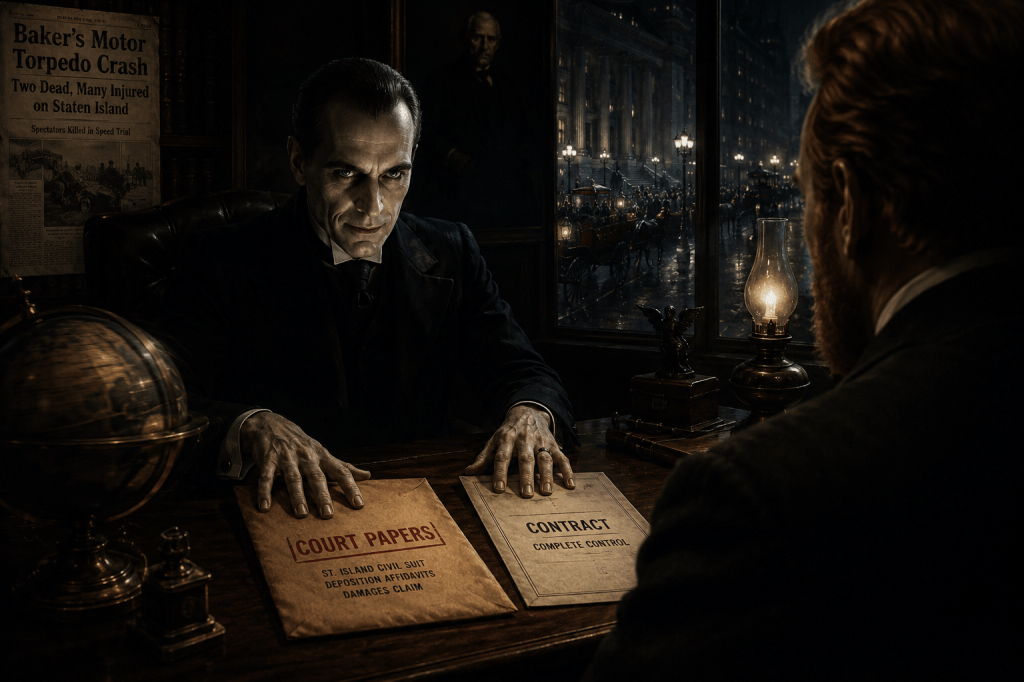


There was a commotion on wintry Madison Avenue. Old man J.P. Morgan and his traveling circus of clerks and bodyguards clattered home in a fleet of crimson horse-drawn landaus, concluding another of his theatrical excursions downtown. I was tempted to watch from the window of my study on the second floor of my house on Thirty-Seventh Street, but my visitor, Walter Baker, was twisting in the chair opposite me and craning his neck toward the street like a schoolboy distracted by a parade.
I was inclined to frustrate his curiosity, knowing it would disorient him.
I returned to my desk and sat. Men of action and experience are easier to manipulate in extremes of light or darkness, I have found, being unpracticed in both settings, so the library was dimly lit in accordance with my instructions.
I have been told that my complexion is luminous in the gloom, made paler by long hours indoors and the occasional splash of Radior Talc. Dressed entirely in black, I knew I gave Baker the unpleasant impression of a floating orb above a desk.
Good.
Unease is a useful instrument.
“What is happening?” Baker asked, with a jerk of his brows toward the noise below.
“Nothing of interest,” I said. “Some old fool is having trouble dismounting from a carriage.” I pushed Baker’s contract papers away from me with the nail of my index fingers. “Let us finish this business.”
Baker, founder of the eponymous electric motor vehicle company, was thirty-eight, burly, ginger-haired, and built like a man accustomed to forcing the world aside with his shoulders. He was not a fellow who enjoyed being cornered or closed in on any side. Yet in my study, with my men within call and my house and its effect all around him, his burly strength was all but useless to him.
“Mr. Baker,” I said, and set the marble globe on my desk spinning with the lightest touch, “we have a problem.” The earth turned silently on its brass axis.
I have always preferred spheres and curves to cubes and straight lines. A line ends. A circle returns.
The electric motor appealed to me for this very reason.
“Problem?” said Baker, sitting forward. “How so, Mr. DeBoort? It is a simple enough matter, for heaven’s sake.”
Up to this point the meeting had been brisk, cool, and civil. I had no objection to ending the civility there, but I would remain cool even if Baker did not.
“Simple enough,” I said, “but still a problem. I want complete control of your company, and I will you removed from its operations.”
Baker flushed. His hand tightened on the arm of the chair until the knuckles whitened. Insult, I have found, is often more effective than threat in the opening moves of a negotiation.
“You will me?” he said. “You are ridiculous.”
I am many things – the epithets with which I am scorned by the Newspaper men are generally fitting – but I am not ridiculous.
Baker came to New York, he reminded me, as a courtesy rather than from necessity. There were other men of money – angels in Chicago, in San Francisco – who might be persuaded to invest as silent partners and then leave him to his machines. Yet it was I whom he had approached, because he understood the scale of what might be accomplished if his expertise in electric transport were joined to my battery patents, my motors, my mines, and my factories.
He was not wrong. Joined together we would have been formidable, but I had no taste for being joined to anyone or anything, when I could be formidable alone.
Baker, waving his contract at me, gave me his first, last, and best offer in the tones of a man accustomed to hearing himself admired. A limited partnership, he called it. He insisted he was not a beggar, and I did not bother to correct him; a beggar may be denied, but a vain man may be steered.
I let Baker finish. I held his gaze until, as men do when silence and a stare lengthen beyond conventional expectations, he blinked; whereupon I made my move.
“Is it not the case,” I said, “that you killed two men on Staten Island?”
That struck Baker like an open-handed blow. He choked on the turn in the conversation and answered at once that it had been an accident, long settled, all of it well known from the newspapers.
Baker reddened. “Damn it, man, it was a motor rally You know better than most that scientific progress doesn’t come without taking risks.” He pulled at his starched collar, then at his cuffs sharply.
I knew the public version of what had happened already. During a speed-trial on Staten Island Baker lost control of his motor torpedo and drove three thousand pounds steel, lead-acid battery, and live-wire electric current into a crowd of onlookers. Two spectators died instantly, a score or more were injured, money was paid, Baker’s reputation was bruised. The incident hurt Baker financially if not morally, which was why he’d come to New York, seeking funds.
I took a thick manila envelope from my desk drawer and placed it on top of my desk, and pushed with both hands in his direction as if it were a thing of immense weight.
“These are court papers,” I said, as if pained by the need to speak of such things. “A civil suit claiming damages. Five sworn affidavits, each distinct, each saying that in your eagerness to escape the wreckage, you drove intentionally through a knot of boys. Two of them are crippled for life.” I gave the envelope a deliberate tap-tap as if awakening its contents.
“Interesting news, is it not? The sort of thing the New York police might find worth revisiting.”
I gave the globe another spin. The continents of the world blurred..
“ Obviously, it has nothing to do with me. Still, as a public service, I feel bound to present it into the world.”
Baker stared at me, dumbfounded. That is one of the most useful expressions a face can wear, because it means the mind behind it has ceased to keep pace.
Then I pushed a second thinner envelope toward him. “And this is a new contract. It gives me complete control of your company and makes you three million dollars richer by the end of the week. Enter into this arrangement, Baker, and I believe I can make the other difficulty disappear.” I cast a glance of mild contempt at the thicker envelope for effect.
Baker sprang up, called me a bastard, and suggested several improbable uses for the contract. For a moment he looked as though he might climb right over the desk at me, but I have never been much troubled by displays of temper. Anger narrows a man’s imagination. While he shouted, I pressed the button fixed beneath the desk.
“I suggest you calm yourself, Mr. Baker,” I said. “This meeting was your idea. You have put me in the middle of this muddle by pure chance, yet finding myself here, I think I may be helpful.” At that, the oak door opened and two large Italians entered the study, both dressed in black overcoats.
The were followed by Anatol Griessman. More a threatening mass than a man of service.
Griessman and the Italians uneased Baker, but he was not so easily cowed, declaring that he was not the kind of man to be pushed about, not by me or by my men, and with that said, insisted that he was leaving.
“You are entirely welcome to leave,” I told him, gesturing toward the men, who did nothing to corroborate that utterance, “but we know where to find you, we know what you do, and we know something of your peculiarities.”
Baker stiffened, turned back to me, and demanded to know what I meant.
I was beginning to bore of the charade. “Only that we know where you go when you are in town.”
“What are you babbling at, man!” said Baker, wrinkling his nose and sneering.
I leaned back in my seat, fingertips touching lightly in repose.
“The Excise at the Bowery. The Slide on Bleecker Street. The basement. The company of the lovely Princess Jolo.”
The color left Baker’s face so quickly it was almost elegant. In that instant he understood the shape of the trap.
“My man, Griessman,” I nodded at the gray man that stood between Baker and the door, “tells me that Princess Jolo is an exotic receptacle of affection.”
A man may forgive a blow to his fortune; he cannot forgive a hand laid on the life he keeps hidden from his wife, his daughters, and his city.
Baker seized as if gut-punched.
“Cleveland must be so dull for you,” I said, “and for your lovely wife—and daughters.”
Baker tried to speak but could not manage it. Whatever was in his mind had become a tangle too tight to pull apart in language.
I gently told him that I was not really a man of depth, only a man attentive to how the world arranged such matters as ethics long before I arrived on the scene.
“Men,” I said, “must find succor between the thighs when and where they can.”
The law, I said, is delightfully liberating because it relieves us of the burden of wrestling with right and wrong; it simply names them and charges a fee for transgression. As for appetite, desire, and the forms in which men seek consolation in one another, I’d said more than I needed to, perhaps because I was tired, perhaps because the century had made hypocrites of us all and that this crumb of brotherhood might push him toward the three million settlement.
In truth I would rather have my adversaries dead and buried than merely persuaded; a properly final solution produces neither loose ends nor lingering guilt, especially when the labor of wrapping things up is delegated to a man like Griessman.
Baker signed the revised contract before my men escorted him from the room, and for the moment that was enough.
The lights in the study flickered. Morgan and his circus were home for the night, drawing down the electricity supply at the expense of the neighborhood. I set the globe spinning again and watched it turn. Its northern cap lacked any meaningful terrain or ocean detail, as though the world itself confessed ignorance at the top of things.
“Griessman,” I said, once the contract was safely locked away in my desk, “now that Mr. Baker has signed, it makes sense for him to disappear. Perhaps our Black Hand friends can assist.”
Griessman was faithful as a dog but of a breed that demanded respect in return; gray-haired, heavy-jowled, hooded eyes, his fleshy face seemed made of wax left too close to a stove. His principal talent was the projection of violence and the invention of undesirable outcomes for our foes and competitors.
“Before or after he deposits the check?” he asked.
It was like listening to gravel in a barrel.
A lesson from Machiavelli came to mind. “Let Baker cash the check,” I said. “The money will be well spent on his widow and children.”
Griessman agreed that it tied up the loose ends nicely. I suspect he also considered whether the widow and children themselves might someday become loose ends, but he had learned not to burden me with every last detail of his operations.
Bombs were his latest fetish.
It had been a successful day’s work. I now controlled Baker’s electric vehicle company and, with it, the patents and proven designs for the coaxial engine, the prismatic batteries, and the rotating anode. By morning I would arrange for six of Baker’s engines to be shipped to the Aerostat Farm near Milwaukee. His earth-bound automobiles could go to the devil. I had more immediate uses for the electric motors in flying machines..
I gave my globe another spin.
The exploration of the Arctic.
The discovery of the North Pole.
My vision was advancing, piece by piece, but I was still missing two critical components: a map, and a navigator.
I glanced out the window. It was snowing. The lights were on in J.P.Morgan’s study across the road. One unforeseen benefit of electricity is that it allowed the conduct of business at all hours.
Patience has never been among my virtues. I prefer events to occur quickly, obediently, and under supervision. Yet even I must depend at times on the eyes and ears of men scattered far from my house and beyond my sight. That evening there was nothing more to be done, and so I found myself, absurdly, at a loose end of my own.
Men must find succor where and when they can.
I picked up the Kellogg intercommunicating telephone on my desk. “Fetch Josafina,” I said. I paused, rubbing my thumb along the jagged scar on my forearm. Perhaps it was a mistake?
“Make sure she is not carrying a weapon this time.”


Leave a Reply